Gravel Garden Ideas: 9 Ways to Make It Feel Designed


A gravel garden looks designed when the gravel has a clear job. Give it a purposeful shape, a firm base, confident edges and enough planting to soften the stone. Then repeat a small material palette that makes sense beside the house.
What makes gravel feel temporary is rarely the gravel itself. It is usually the absence of a plan: an undefined expanse, several unrelated colours, plants dotted about like afterthoughts, or a route that is difficult to walk across.
These nine design rules will help you decide where gravel belongs, which type to choose and when another surface would work better.
1. Decide what the gravel needs to do
Start with use, not a sample bag. A sitting area, a side return, a planted gravel bed and a driveway put very different demands on the material below your feet.
Occasional garden route: loose angular gravel can give a relaxed, permeable feel.
Main route to the door: prioritise a stable, even surface and comfortable access in all weather.
Dining or furniture area: check that chair legs, tables and a barbecue can sit level; generous paving pads may be more practical.
Planted gravel garden: the soil, drainage and plant choice matter as much as the decorative top layer.
Driveway: the sub-base, vehicle movement, thresholds and drainage need a properly specified construction.
Mark these activities on a simple plan first. Gravel can then connect spaces instead of becoming the default surface for every leftover corner.
2. Use gravel to draw a strong shape
A convincing gravel layout is legible from the house. It might form a clean rectangle aligned with doors, a generous curve around planting, or a route that widens naturally at a seat. Indecisive little wedges and narrow strips tend to collect debris and make the garden feel pieced together.
Think in broad shapes and allow plants to overlap their edges. That contrast between a simple ground plane and looser planting is what makes many successful gravel gardens feel calm rather than empty.
3. Choose the aggregate by movement, not colour alone
The RHS gravel-garden guidance notes that medium-grade angular gravel is generally easier to walk on than small rounded pea shingle or large cobbles. The angular pieces interlock more readily; rounded stones tend to move underfoot.
Buy the smallest sensible sample quantity and test it where it will be used. Walk over it in everyday shoes, move a bin or wheelbarrow across it and place a chair on it. A stone that looks beautiful in your hand may be tiring across a long route.
Colour still matters. Warm buffs and browns often sit comfortably with red brick, while greyer stone can relate to slate roofs, zinc details or cooler paving. Aim for a quiet connection rather than an exact match.
4. Design the edge before ordering the stone
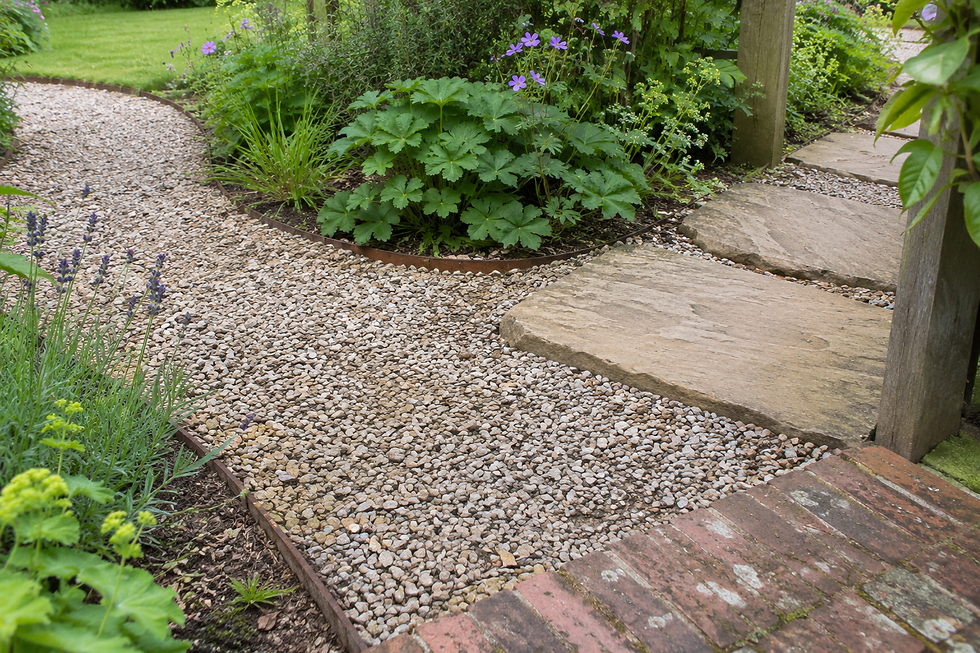
Without containment, loose gravel migrates into lawns, planting beds and drains. An edge also turns the surface into a deliberate shape.
Slim steel can almost disappear; brick can pick up the house; setts add a more traditional frame; and a stone kerb can hold a level change. The right choice depends on the wider palette and the loads it must resist. A driveway edge is doing more work than a border around a lightly used path.
Pay particular attention at doors, gates and paving. These small junctions are where gravel is most likely to spill or create a trip, so use a clear threshold and avoid awkward slivers.
5. Build a base for the actual use
Decorative gravel should not be treated as the structure. The ground beneath needs to be excavated, prepared and compacted for the intended load, with falls and drainage resolved before the top layer arrives. The specification for a pedestrian path is not the same as the specification for cars.
Landscape fabric can help separate layers and suppress some weeds in suitable situations, but it does not make a surface maintenance-free. Wind-blown soil and organic matter will still settle between stones, where new weeds can germinate.
If the garden already holds water, do not assume a bag of gravel will solve it. Read our new-build garden drainage checks before changing the surface. Compacted subsoil, poor falls and nowhere for water to discharge need to be understood first.
6. Do not confuse “permeable” with “suitable everywhere”
For front gardens in England, the Planning Portal guidance explains that a new or replacement driveway does not normally need planning permission when it uses permeable surfacing such as gravel, or directs water to a lawn or border. Traditional impermeable surfacing over five square metres is treated differently. Local restrictions and rules elsewhere in the UK can vary, so check before work begins.
Even permeable gravel relies on what sits below it. A compacted or saturated base can still cause runoff and puddling. The design needs to consider soil, levels, thresholds and a safe route for excess water—not just the visible finish.
7. Keep the principal route accessible
Loose gravel is not a universally accessible surface. Sensory Trust guidance on paths and routes advises avoiding loose materials for accessible paths because they can be difficult for people with limited mobility and often impossible for wheelchair users.
If the route serves the front door, bins, a pushchair, a wheelchair or frequent garden traffic, consider smooth paving, a bound or properly stabilised system, or a paved line through a wider gravel area. Keep thresholds flush and make the route wide enough for its users.

8. Let planting occupy more space than you first expect
Gravel becomes a garden when plants feel embedded in it, rather than placed around its edge. Use substantial planting islands, repeat a few dependable species and leave room for their mature spread. A small tree or large shrub can provide the height that a low gravel plane otherwise lacks.
Beth Chatto’s influential Gravel Garden began as an experiment in drought-tolerant planting on a former car park. Its lasting lesson is not that every gravel garden should imitate a dry Mediterranean scheme; it is that plants should suit the actual conditions. The Beth Chatto Gardens account describes how the design grew from plants already succeeding in dry, free-draining places and from observing natural landscapes.
In a sunny, free-draining UK garden, lavender, santolina, phlomis, euphorbia and airy grasses can be useful starting points. On heavier or wetter ground, forcing that palette is likely to disappoint. Improve the site where practical, but select plants for the conditions that remain.

9. Plan for leaves, weeds and top-ups
Gravel is lower input than a lawn in some settings, but it is not no-maintenance. A useful routine includes raking disturbed areas, removing leaves before they break down, pulling small weeds while they are easy, keeping edges clear and topping up thin patches when needed.
Avoid blasting leaves with a powerful blower set so high that it moves the aggregate too. In planted areas, a spring tidy and selective editing of seedlings is usually more realistic than trying to keep every stone spotless.
Five mistakes that make gravel look unfinished
Covering the whole garden because gravel seems cheaper than resolving the layout.
Choosing rounded, oversized or very deep loose stone for a busy walking route.
Mixing several unrelated gravel colours, pavers and edging materials.
Leaving narrow unplanted margins beside fences and walls.
Assuming permeable surfacing removes the need to design drainage and levels.
For more help shaping the route itself, see our guide to creating better garden paths. It covers width, direction, destinations and how a path changes the experience of the garden.
Design the gravel as part of the whole garden
Gravel works best when it is specified alongside levels, routes, planting, furniture and drainage—not added after those decisions have already been made. That joined-up thinking also gives a landscaper a much clearer brief and reduces expensive changes on site.
Urban Plot’s human-led garden design service can turn those decisions into a practical layout, material direction and planting plan tailored to your home and how you want to use the space.