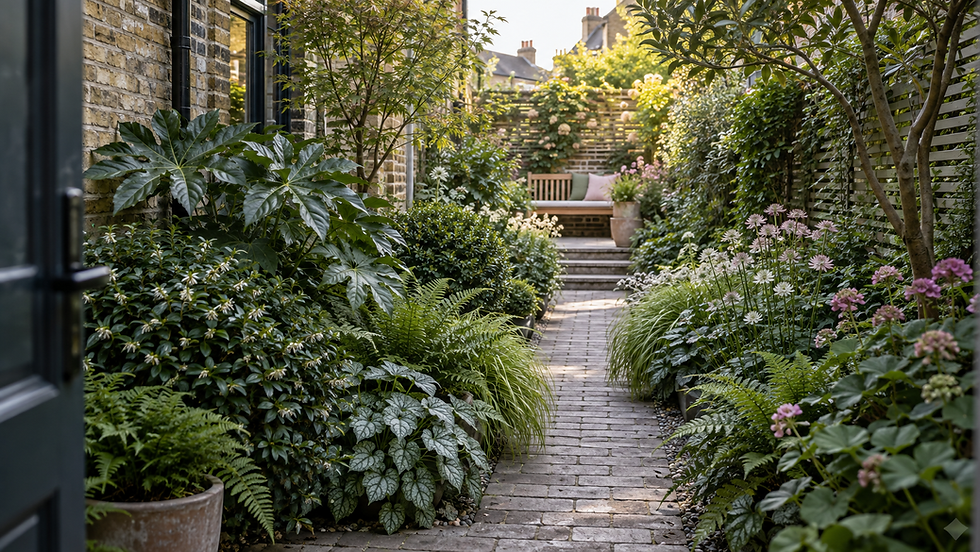
7 Trees for Small Gardens That Earn Their Space (and How to Choose)


Design idea: one well-chosen tree can create privacy, shade and year-round structure without swallowing a compact garden.
The best tree for a small garden is not simply the shortest one in the nursery. It is the tree whose mature spread, canopy shape, roots and seasonal character fit the space and do a useful design job. Choose for the garden you will have in ten years, not the plant you can carry home today.
This guide gives you seven strong UK options, but the real value is the selection method. If you are also working out where screening belongs, start with our new-build garden privacy ideas before buying a row of trees.
Start with the job, not the tree
In a small garden, every large plant has to earn its footprint. Decide what you need most: a light canopy over a seat, privacy from an upper window, spring blossom, edible fruit, evergreen structure or a focal point that looks good from the kitchen in winter.
The RHS recommends checking mature height and spread, season of interest, whether the tree is evergreen or deciduous, and the effect on neighbouring gardens. It also suggests drawing the mature canopy on a scale plan. That simple circle is often more revealing than the height printed on a nursery label. See the RHS guide to trees for smaller gardens.
Award-winning garden designer and tree grower Jamie Butterworth makes a similarly useful point: look at what a tree will become in five to ten years and ask what it contributes in every season. That is good design discipline when there is room for only one specimen. His advice is summarised by The Middle-Sized Garden.
The five checks that prevent an expensive mistake
Measure the available spread as well as the height. A broad 4m tree may be harder to place than a narrow 6m one.
Check soil drainage, pH, sun and exposure. A compact cultivar still fails if the conditions are wrong.
Plot the canopy at maturity and consider which neighbouring windows, borders and seating areas it will shade.
Locate drains, inspection covers, paving and foundations before digging.
Choose a naturally suitable habit rather than buying a vigorous tree and planning to keep it small forever.
Most trees near buildings cause no damage, but risk is site-specific. Shrinkable clay soils, older shallow foundations, leaking drains, species water demand and distance all matter. The RHS advises professional input where the risk is uncertain, particularly on clay or near extensions; there is no honest universal planting distance that suits every tree and property. Read the RHS guidance on trees near buildings.
1. Amelanchier alnifolia ‘Obelisk’: vertical structure for a narrow plot
Amelanchier alnifolia ‘Obelisk’ is one of the clearest answers when width is the constraint. The RHS gives an approximate mature size of 4m high by 1m wide. It brings white spring flowers, summer foliage and autumn colour in a distinctly upright shape.
Use it to pull the eye upwards at the end of a side return, mark a change between terrace and lawn, or add a soft screen without building a dense green wall. It still needs root space, water while establishing and enough room away from the path for its trunk to develop.

Design idea: a narrow canopy adds height and seasonal colour while keeping the route usable.
2. Cercis chinensis ‘Avondale’: blossom for a warm, sheltered position
Cercis chinensis ‘Avondale’ is listed by the RHS at roughly 3m high and 2m wide. Its spring flowers appear on the bare wood, so it can make a strong focal point before the rest of the border wakes up.
Give it a warm, sheltered position and free-draining soil. In design terms, it works best where the trunk and branching can be seen rather than buried inside a crowded evergreen border. Place it where the spring display is visible from the house.
3. Magnolia stellata ‘Jane Platt’: a soft focal point near the house
Magnolia stellata ‘Jane Platt’ is given an approximate mature height of 3–4m and spread of 2.5m by the RHS. The starry spring flowers suit a calm, simple scheme and the branching remains attractive after flowering.
Magnolias dislike unnecessary root disturbance, so allow a proper soil area rather than squeezing one into a tiny cut-out in paving. Early flowers can be affected by exposed frost pockets; a sheltered position lets the display last longer.
4. Cornus kousa ‘Miss Satomi’: flowers, fruit and autumn colour
Cornus kousa ‘Miss Satomi’ is an RHS Award of Garden Merit cultivar, listed at about 5m high by 3m wide. It offers more than one moment: coloured bracts, ornamental fruit and autumn foliage.
That multi-season performance makes sense when one tree has to carry a large part of the planting composition. It prefers neutral to acid soil, so check the site rather than choosing on appearance alone. If your soil is strongly alkaline, select a tree that genuinely wants those conditions.
5. Euonymus europaeus ‘Red Cascade’: wildlife value with vivid autumn detail
Euonymus europaeus ‘Red Cascade’ is a cultivar of a British native, listed by the RHS at approximately 3m high and 2.5m wide. Its autumn foliage and colourful fruits can bring a less manicured, more natural character to an urban garden.
Use it beside grasses, seed heads and simple evergreen structure rather than surrounding it with competing seasonal colour. The fruits are ornamental, not for people to eat, so consider household use and supervise children or pets around unfamiliar plants.
6. Liquidambar styraciflua ‘Gum Ball’: a rounded crown without a huge tree
Liquidambar styraciflua ‘Gum Ball’ is listed by the RHS at around 3m high and 2m wide. Its compact, rounded habit and autumn colour can create a clear architectural accent where a full-sized sweet gum would be completely unsuitable.
This is useful beside a simple terrace or at a path junction where the crown can be read as a deliberate shape. Allow an unpaved area around the base and check soil suitability; compact form does not remove the need for healthy rooting conditions.
7. Sorbus pseudovilmorinii: an airy canopy for a planted garden
Sorbus pseudovilmorinii is listed by the RHS at approximately 4m high and 4m wide. It is not the narrowest choice, but its fine foliage and lighter canopy can feel less oppressive than a dense evergreen of similar spread.
Use it where you have enough width for the crown and want a tree to sit among perennials rather than dominate them. A light-canopied tree is often the better answer near a seating area because it filters light instead of creating a heavy block of shade.

Design idea: blossom, fruit and autumn colour give a small tree more than one season in which to earn its place.
What about crab apples, cherries and fruit trees?
They can be excellent choices, but the exact cultivar, grafting height and rootstock matter. A label that says ‘apple tree’ tells you very little about eventual size. For edible apples and pears, ask the nursery for the rootstock and likely mature dimensions in your soil. For ornamental cherries, check both the cultivar and whether it has been top-worked onto a clear stem.
The image above shows the design value of a crab apple: a light canopy, spring blossom and autumn fruit. It is a strong option when you want seasonal change and wildlife interest, but choose the named cultivar by its verified mature dimensions rather than assuming every crab apple stays small.
Place the tree as part of the layout
A common mistake is pushing the tree into the far corner because that is where there appears to be spare ground. The result can shade the neighbour, hide the trunk and make the tree feel incidental. Moving it slightly forward may create better depth and place the canopy over planting rather than over a fence.
Urban Plot’s view is to position the trunk first on plan, then draw the mature canopy. Test the sightline from the main room, the shade at seating times, access for pruning and the relationship with paths. A tree should organise the space beneath it, not simply fill a gap.
Trees also contribute shade and evaporative cooling. Forest Research notes that urban tree cooling depends on thoughtful placement, suitable species and enough space and resources for the tree to grow. That is another reason to avoid cramming a large-growing tree into an undersized soil pocket. See the Forest Research note on urban cooling.
Plant it properly: October is useful, not magic
Autumn to spring is generally the best period to plant trees while the ground is neither waterlogged nor frozen. Cooler conditions reduce water stress, but a newly planted tree still needs attentive watering through dry spells during its first years.

Planting detail: keep the root flare level with the surrounding soil, mulch the root zone and leave the stems clear.
Soak the rootball before planting and loosen tightly circling roots gently.
Dig no deeper than the rootball, but make the planting area substantially wider.
Set the point where roots meet the trunk level with the surrounding soil.
Water thoroughly, then mulch 5–8cm deep while leaving a clear gap around the trunk.
Stake only where needed, check the tie as the trunk expands and remove support once established.
Water regularly during dry periods for at least the first year or two.
Those steps follow the RHS tree-planting method. On wet heavy clay, it can be better to wait than to plant into saturated ground and damage the soil structure.
A quick decision rule
If the garden is narrow, start with columnar forms. If there is room for a 3–4m canopy, prioritise a light crown and several seasons of interest. If the tree sits close to buildings or services, treat soil, foundations and drainage as a site assessment rather than relying on a distance copied from the internet.
And if the only way a tree fits is through relentless pruning, it is probably the wrong tree. A large shrub, climber on a freestanding frame or carefully placed screen may solve the same problem with less long-term conflict.
Choose the tree with the whole garden in mind
A tree changes light, privacy, views and the scale of everything around it. If you are planning a wider redesign, Urban Plot’s garden design packages can place the tree, routes, seating and planting as one coherent scheme rather than a series of separate purchases.
Already have a plan and need help sourcing the planting? You can also request plants in bulk from Urban Plot once the species, sizes and quantities are settled.
Sources
Royal Horticultural Society — Trees for smaller gardens; Trees near buildings; How to plant a tree.
Forest Research — The role of urban trees and greenspaces in reducing urban air temperatures.
Woodland Trust — Where to plant.
West Midlands Combined Authority — Right Tree, Right Place.
The Middle-Sized Garden — interview with award-winning designer and tree grower Jamie Butterworth.